

Black History Month and the Battle for Truth
Our Roots, Our Voice is a series from our leadership team to highlight challenges, provide insight and call to action for our community.
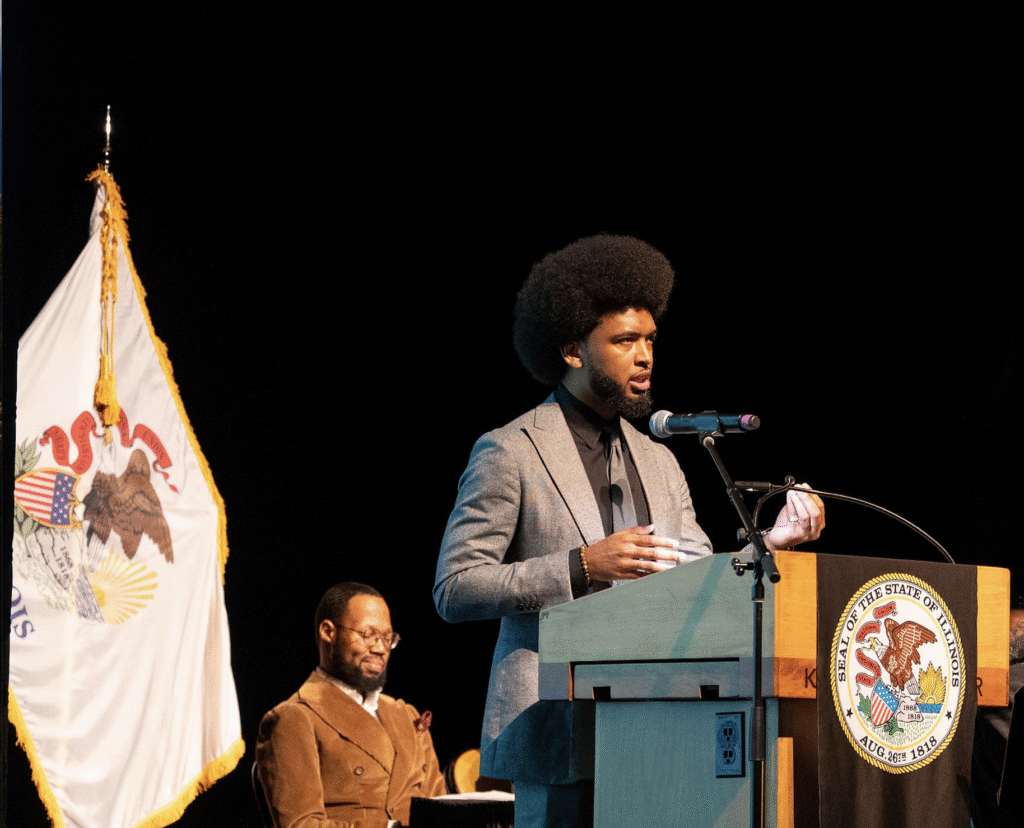
By Clinton Boyd, Jr., Ph.D., Executive Director of Fathers, Families, & Healthy Communities
Every February, Black History Month invites the nation to pause. We commemorate heroes, retell familiar stories, and offer public affirmations of Black excellence. These gestures matter. They acknowledge a truth that has too often been denied: Black people have shaped the moral, spiritual, cultural, intellectual, political, and economic fabric of this country and the world.
But Black History Month was never meant to be ceremonial. It was meant to be corrective. And it was never intended to exist apart from the ongoing struggle for dignity, equity, and justice.
The origins of Black History Month are instructive. Carter G. Woodson did not create Negro History Week to make America feel better about itself. He created it because Black life and Black genius were systematically erased, distorted, or dismissed in schools, public institutions, and historical narratives. His aim was not to isolate Black history into a narrow window of time, but to expose a deeper truth: a society that refuses to teach the full history of its people cannot claim to be committed to democracy or justice.
Woodson understood something that remains just as urgent today. Self-knowledge is the foundation of self-respect. A people disconnected from their history become more vulnerable to erasure, manipulation, and the steady stripping of their humanity.
That is why this current socio-political moment, marked by rising authoritarianism and the deliberate spread of disinformation, should concern us all.
We are witnessing an aggressive effort to roll back historical truth. Books are banned. Curricula are sanitized. Educators are silenced. Entire histories are deemed too uncomfortable to name. This hostility toward Blackness and toward honest reckoning is not incidental. It is strategic. Erasure has always been a strategy of control.
Yet what these efforts consistently fail to acknowledge is that Black history does not belong to Black people alone.
Black genius has been a gift to the world. Modern music, from jazz to hip hop, is rooted in Black creativity and has shaped global culture. Medical advances, agricultural innovations, and scientific breakthroughs pioneered by Black thinkers have saved lives across continents. Political movements for labor rights, gender rights, civil rights, and human rights, worldwide, have drawn directly from Black freedom struggles. Entire economies, academic fields, and cultural institutions have flourished because of Black innovation, often while denying Black people credit, protection, or access.
Erasing Black history does not merely harm Black communities; it deprives the world of the wisdom, creativity, and truth that make collective progress possible.
And still, Black history in America is too often framed almost exclusively through the lens of oppression. We rightly honor the resilience and achievements of Black people who created, led, and innovated while living under racial subjugation. That story matters. It reveals courage, brilliance, and resistance in the face of injustice.
But true Black history demands more than survival narratives alone.
Our story does not begin with enslavement in the United States. Enslavement was a rupture, not an origin. Long before forced displacement, African civilizations governed complex societies, cultivated advanced knowledge systems, developed philosophies, built global trade networks, and practiced forms of collective care that sustained generations. These civilizations shaped mathematics, medicine, architecture, agriculture, astronomy, astrology, and governance in ways that influenced the development of the modern world and enriched cultures far beyond the African continent.
When Black history is reduced solely to suffering, it narrows both truth and possibility. It reinforces narratives designed to justify domination by obscuring the fullness of who we have always been. Honoring Black history requires remembering Black people as whole, not only as survivors of injustice, but as originators of knowledge, builders of civilization, and contributors to humanity itself.
This struggle over history is not abstract. It shows up in how our systems treat Black families today.
At Fathers, Families, & Healthy Communities, this truth animates our work. We partner with Black fathers and families navigating systems that were never designed to see us as assets. Too often, these systems meet Black men with suspicion instead of support, and punishment instead of possibility. History tells a different story.
Black fathers have always been anchors of families, stewards of culture, and carriers of wisdom, even under conditions meant to fracture us. Our resilience is not accidental. It is inherited.
Black history lives in the daily persistence of fathers who remain present despite economic exclusion, carceral systems, and narratives that seek to erase our value. It lives in families who continue to love, nurture, and dream while carrying ancestral knowledge forward. To honor Black history is to confront the systems that undermine these realities and to commit to building structures that restore dignity rather than deny it.
This is why Black History Month must be both a celebration and a reckoning.
The individuals we honor today were not embraced in their own time. They were disruptive and unwilling to accommodate injustice. They challenged unjust power directly and without apology, often at great personal cost.
If Black History Month feels comfortable, it risks becoming performative. Discomfort is not a failure of the moment; it is a signal that truth is colliding with injustice.
And our remembrance must extend beyond the most recognizable names. We must also honor the programs, movements, and political visions of Black liberators whose work was dismissed as too radical, too local, or too threatening to white supremacy to ever be fully embraced or celebrated. Their ideas, organizing strategies, and visions for collective liberation continue to shape the struggle today, in defiance of dominant historical narratives that have repeatedly worked to erase their contributions to Black liberation.
And when institutions refuse to tell the full story, Black communities have never waited for permission. We have always stepped in to protect the truth.
Across generations, Black people have preserved history in churches and mosques, in kitchens and living rooms, in barbershops and beauty salons, and through mutual aid networks and community rituals. When formal classrooms were closed or hostile, we built our own. When knowledge was policed, we carried it by hand and by heart. That tradition is not a relic of the past. It is alive and necessary today.
Teaching our children who they are and where they come from is not an act of defiance for its own sake. It is an act of love. It is an act of survival. And it is an act of responsibility to generations yet to come.
Black History Month, then, is not a look back. It is a call forward.
It calls on civic leaders, policymakers, funders, and institutional allies to abandon performative commitments and embrace genuine accountability. It requires a clear-eyed examination of whether resources are aligned with justice, whether policies actively restore dignity, and whether the systems we uphold are accountable to the people whose labor, culture, and resilience sustain them.
Black history is not seasonal. It is living. It is expansive. It is ongoing.
When Black people know themselves, self-love becomes possible. When self-love takes hold, we protect one another. And when we protect one another, we build communities that strengthen the entire world.
The question is not whether Black history matters. The question is whether we are willing to honor it fully, truthfully, and every single day.
